The acts
Fire show acts, explained
Torches, poi, the fire staff, fire breathing, fire eating and the fire knife: what each act is and where it comes from, before you watch on the sand.
Book a seat by the fire ↗Quick answer
A fire show is built from object-manipulation skills done with lit wicks: torch juggling, poi spinning, staff spinning and the Samoan fire knife, plus mouth skills such as fire breathing and fire eating. Some roots are ancient, some recent. The troupe on Krating Lai Beach sets its own running order, so treat it as background on what may appear, not a programme.
What counts as fire performance
Fire performance covers arts and skills that involve handling fire, usually with equipment carrying one or more wicks that hold a flame big enough to read from a distance. It includes skills based on juggling, baton twirling and poi spinning, as well as fire breathing, fire eating and body burning, sometimes grouped as fakir skills. Shows can be choreographed to music, freestyle or built around talk with the audience. Fire skills appear at beach parties, festivals and corporate events, and performers treat safety as the first rule, summed up in the saying learn before you burn.
Torches: the oldest trick
A fire torch is a club or baton with a wick at one end, swung like Indian clubs or tossed end over end like a juggling club. One of the earliest written accounts of fire performance comes from the water-drawing celebrations at the Second Temple in Jerusalem, around the first century, where a rabbi is said to have tossed eight burning torches upwards with one hand, catching each without any touching. Spinning torches are still a staple, and they head the list of acts the Krating Lai restaurant describes for its own show.
Poi: from the Māori to the beach
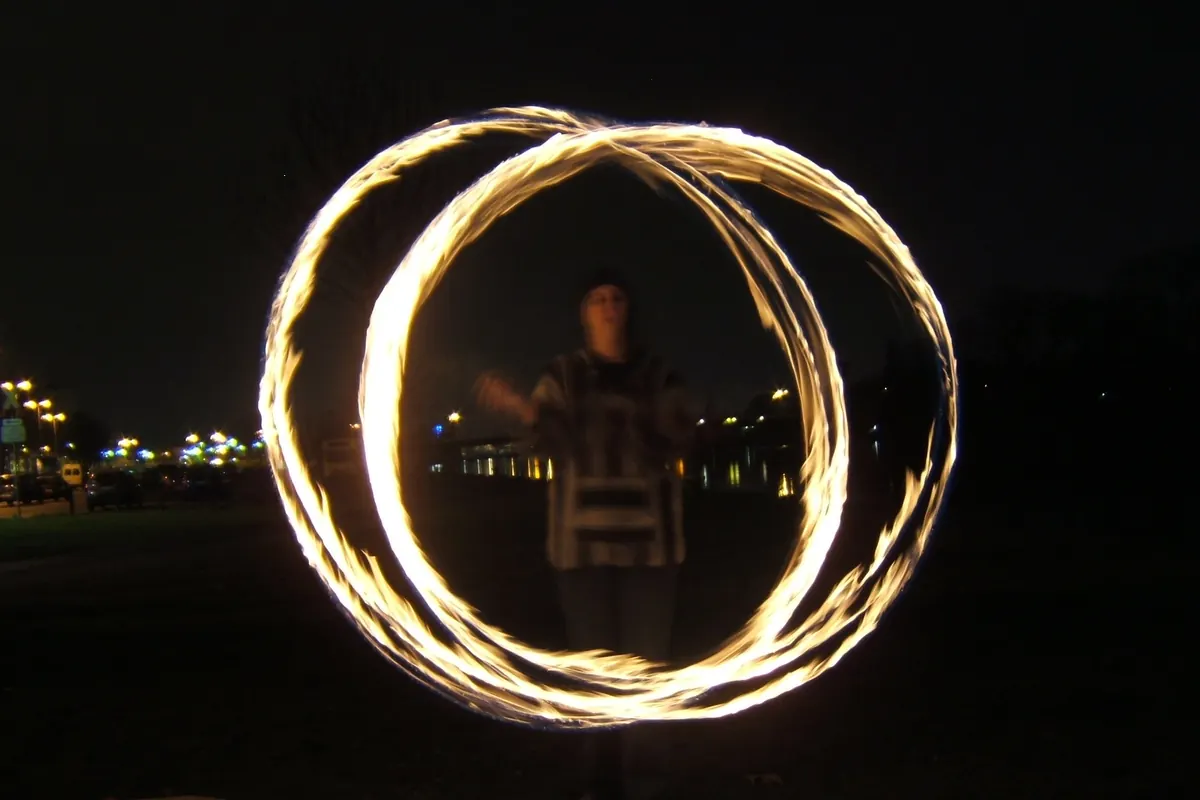
The poi is a Māori invention from New Zealand: a ball on a cord, traditionally swung in rhythmic patterns by women, often with singing. The word can mean the object, the choreography or the music. Fire poi swap the ball for a wick of flame-resistant material such as Kevlar, soaked in fuel and lit. Lighting poi is believed to have started in Hawaii in the 1950s as a tourist attraction. Today poi is spun worldwide, mostly by people who teach themselves or learn from each other.
The staff and the dragon staff
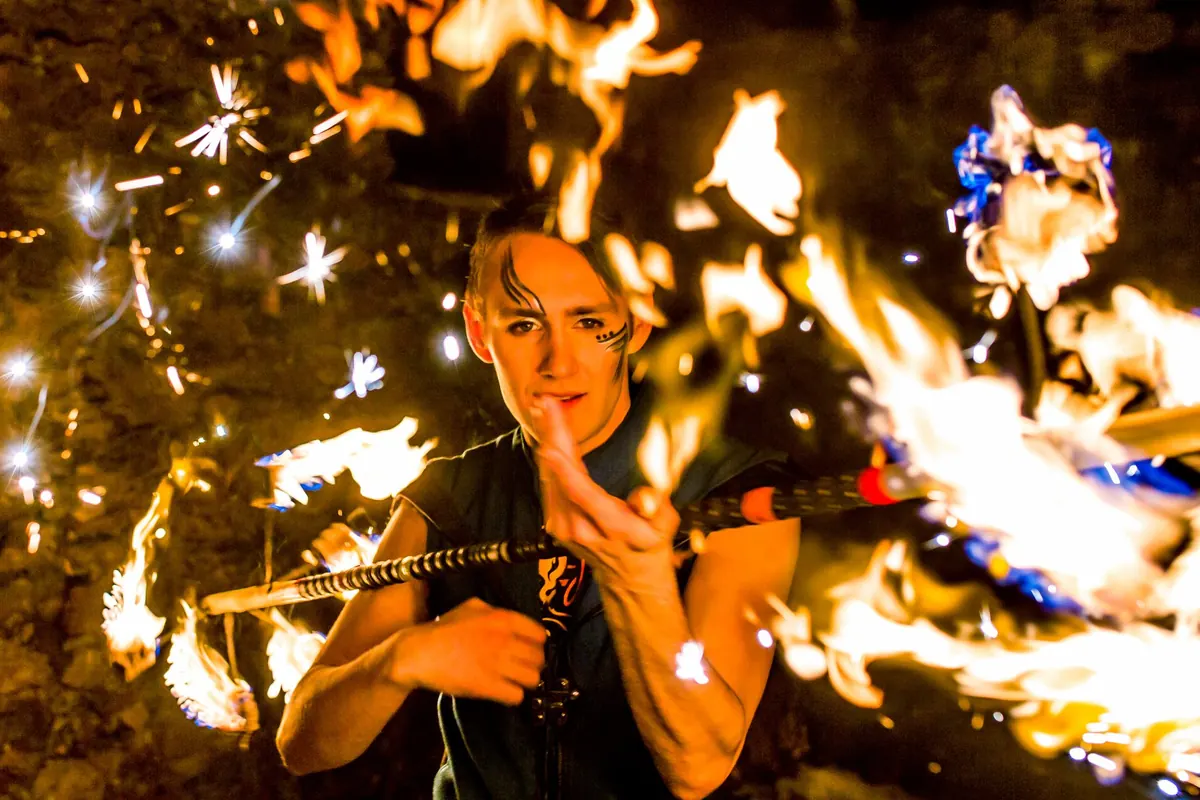
A fire staff is a pole of wood or metal with wicks at one or both ends and its balance point in the middle; lengths run from half a metre to two metres or more. Performers either spin it with their hands or roll it over arms, legs and body, a style called contact staff. The dragon staff carries a cross of three or more wicks at each end, which adds momentum and lets it roll in intricate patterns. A burnoff is the moment a spinning staff throws excess fuel off its wicks as two balls of fire.
Fire breathing
Fire breathing makes a plume of flame by spraying a fine mist of fuel from the mouth over an open flame. It is dangerous however carefully it is done. Most professionals learn it as apprentices to an experienced performer, keep a trained safety assistant with a fire blanket and extinguisher nearby, and choose fuels with a high flash point such as paraffin. Almost every serious recorded injury involves untrained people, which is why it belongs to professionals and not to a holiday experiment.
Fire eating
Fire eating means putting a flaming object into the mouth and putting it out. It works by cutting off the oxygen and by the brief cooling of moisture on the surface, not because the flame is cold. Fire eating was part of Hindu, sadhu and fakir performances as a sign of spiritual attainment, and it became a standard sideshow act in the late 1880s, often one of the first skills a sideshow performer learned. Even skilled fire eaters accept small burns and exposure to fuel as part of the job.
The Samoan fire knife
Samoa gave the fire show its knife. The original was a machete with towels bound round each end and a stretch of blade showing between them; lit, it became the centre of a ceremonial dance, siva afi. That dance traces back to ailao, in which Samoan warriors showed off by whirling, throwing and catching a war club. Fire knives have been in use since the 1940s and are the traditional Polynesian fire implement; many traditional fire shows take their cue from the yearly World Fireknife Competition and Samoa Festival. Not every beach troupe uses one.
The fire pump and the running order
The restaurant on Krating Lai Beach bills its fire-pump act as the tallest in Thailand. That is its own description rather than a measured record, so watch it for the spectacle, not the statistic. The show also mixes spinning torches with acrobatics. As with any troupe, the running order is the performers' to set, and the whole fire show lasts about 20 to 30 minutes depending on the wind.
Read next: Pattaya beach fire show: worth it?
Frequently asked questions
Is fire poi a Thai tradition?
No. Poi comes from the Māori of New Zealand, and fire poi is believed to have started in Hawaii in the 1950s. It is now spun worldwide, including on Thai beaches.
Will I see fire breathing at the Pattaya show?
The troupe sets its own programme, so no single act is promised. Spinning torches, acrobatics and the fire pump are what the restaurant describes.
Is it safe to sit close?
Seats are close enough to feel the heat. Professional fire performers work with safety equipment, and anyone with a heart condition is advised against going.
Sources
- Fire performance, an encyclopedia entry (English Wikipedia)
- Poi (performance art), an encyclopedia entry (English Wikipedia)
- Fire staff, an encyclopedia entry (English Wikipedia)
- Fire breathing (circus act), an encyclopedia entry (English Wikipedia)
- Fire eating, an encyclopedia entry (English Wikipedia)
- Fire knife, an encyclopedia entry (English Wikipedia)